
What If You Showed Up for Yourself the Way You Show Up for Your Clients?

Not long ago someone said to me — half compliment, half question — "You're a therapist. You know all the ways you should be doing this."
They were talking about parenting my kids.
And they weren't wrong. I do know the research. I know the attachment frameworks, the regulation strategies, the importance of repair after rupture. I've sat with hundreds of families and helped them navigate exactly this terrain.
What I didn't say out loud was the part that hung in the air between us — the hesitation behind their words that I recognized immediately because I've felt it myself:
Knowing and doing are not the same thing.
We spent the next portion of our conversation talking about something that doesn't get discussed enough in our field — how clinicians, of all people, are often the worst at applying what we know to our own lives.
Just because you know all the tools doesn't mean you're good at using them yourself.
If that landed somewhere tender, keep reading. This one is for you.
The Gift That Becomes the Wound

We didn't get into this field by accident. Something drew us here — a capacity to feel deeply, to notice what others miss, to stay present in pain when most people look away. That sensitivity is not incidental to our clinical work. It is our clinical work.
It is also, when left unsupported, the thing most likely to break us.
I know this not just as a clinician. I know it because I lived it.
Burnout was a dread in the morning when I woke up and had to get ready for work. It was a sour attitude about anything and everything. It was an exhaustion that a nap could not fix — a longing for something with no way to satisfy the craving.
It was a pull to do more and more, even though my tank was on empty. If I can just do this, then I'll feel better. It was a bit of my ego saying, "no one else can do it like I can" — and so I isolated myself more and more, failing to ask for help from those around me.
It was sleepless nights, despite being so incredibly exhausted. It was a knot in my stomach that would not go away.
It was like my engine was always revved, ready for the next crisis.
I share this not because burnout is unique to me — but because it isn't. Because I know that somewhere right now a clinician is reading this and recognizing themselves in these words and feeling, maybe for the first time, like someone actually gets it.
Here's what the research on compassion fatigue tells us — and what the Neurosequential Model of Therapeutics helps us understand at a deeper level: the very qualities that make clinicians exceptional are the same qualities that make them uniquely vulnerable to burnout. Your empathy. Your attunement. Your capacity to regulate alongside another nervous system in distress.
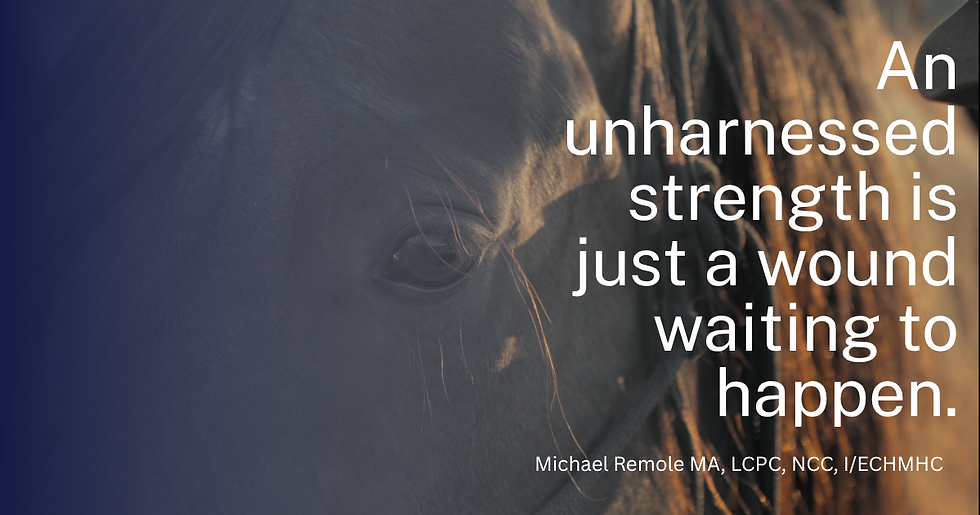
These are not weaknesses. They are strengths. But unharnessed strengths — strengths that are given freely without being replenished — don't stay strengths for long.
An unharnessed strength is just a wound waiting to happen.
What It Actually Looks Like
My burnout, like many other burnouts, did not announce itself. It didn't arrive with a memo. It crept in quietly, wearing the disguise of professionalism, perfectionism, stoicism, and the belief that I should be able to handle this because I know better.
Here's what it actually looks like in the body and in the work:
The things that used to move you no longer do. A client shares something devastating and you notice — with a kind of distant clinical detachment — that you feel nothing. I remember a close friend going through an awful situation and as they told me the horrific details they were facing, I had no response, nothing to conjure up, except a half-hearted "I'm so sorry." Not because I didn't care. It was because my system had been maxed out of the capacity to care anymore. My ability to be me in my personal life was robbed because my professional life was so out of balance, I had nothing to give, nothing to feel. I was empty.
You feel distant. From your clients. From your colleagues. From yourself. You're showing up physically but something essential has checked out. You're going through the motions of a clinician while the person inside the clinician quietly disappears. It felt as if I was watching a video of someone else's life. I was there, but I wasn't. This distance — this disconnect from myself — caused a guilt and shame cycle. Instead of listening, I did what I knew to do. I pushed harder. I tried to achieve more in hopes that I would feel something.
You're more easily irritated or annoyed. The guilt and shame cycle that showed up was similar to that of an addiction cycle. As I came down the cycle, I began to get more and more irritated over the small things. Things that wouldn't have registered six months ago now set off a disproportionate internal response. Then the guilt for the response — add on the shame. With the shame comes the pressure to hold it together to prevent another relapse. No matter how hard you try, you find yourself failing again, and again, and again. The shame compounds the exhaustion.
You've become critical — even resentful. Toward clients who aren't progressing. Toward colleagues who seem to have it together, who practice self-care. Toward the organization that keeps asking more of you. Even toward friends who invite you to social gatherings — but don't they know how busy, how exhausted I am? How dare they ask more of me! Then they stop asking after repeated no's and there are fewer and fewer invites. This evokes more frustration, resentment, and anger. This job is taking everything from me.
Superman Syndrome. It is in the midst of isolation and complete exhaustion that we begin to shift into a delusional "Superman Syndrome." No one can do this job the way that I do — so I stop asking for help and support. It is as if we are rendered to a three-year-old's "I do it myself" attitude, all while that being so far from reality. We can't do it ourselves. So we push harder.
The Body Keeps the Score. Our bodies tell on us. It was during my burnout that I had shingles four times. My doctor ran all kinds of tests to rule out a variety of medical concerns. Everything came back normal and then he said, "Are you under a lot of stress?" I said no. He went on to ask me about my job and I shared about all aspects of what I carried — without any acknowledgment or appreciation for the significance of it. He laughed and said, "Oh yeah, no stress at all."
As I thought about stress and the impact on our systems, it all made sense. My body had been operating in a state of survival. My stress response systems were highly activated — it was as if my engine was revved all of the time, ready for the next crisis to arrive. I couldn't sleep. I had digestive issues that medication barely addressed. My body was screaming at me to listen.
In my defensiveness and defiance, I yelled back like a little toddler throwing a fit:
"I'm not listening to you. I'm not listening to you."
None of this is a character flaw. None of this means we chose the wrong profession.
This is our nervous system doing exactly what nervous systems do when they have been regulating for everyone in the room — clients, colleagues, organizations — without anyone, anywhere, helping to regulate them back.
The Question Nobody Is Asking You
The Neurosequential Model of Therapeutics, developed by Dr. Bruce Perry, teaches us that human beings are fundamentally relational creatures. We regulate in relationship. We heal in relationship. We grow in relationship. This is true for your clients.
It is also true for you.
So here is the question I want to ask you — and I want you to sit with it honestly:
Who is helping regulate your nervous system while you're helping regulate everyone else's?
Who do you allow to help support your system?
For many clinicians, the honest answer is: no one. Or: I don't know. Or: I haven't thought about it that way before.
We are extraordinarily skilled at creating the conditions for others to receive support. We are extraordinarily poor at receiving it ourselves. We know every defense mechanism in the clinical literature — and we deploy most of them when someone tries to take care of us.
The same framework you use to understand your clients applies to you. Regulate first. Everything else follows. You cannot pour from an empty vessel. You cannot co-regulate from a dysregulated state. And you cannot sustain meaningful clinical work — the kind that actually changes lives — without someone, something, somewhere replenishing what the work asks you to give.
We've Been There
I want to say something that doesn't always get said in professional development circles:
We built Gateway Family Services — in part — because we had been there. Because we knew what it felt like to give everything to the work without anyone filling the cup back up. Because we believed, deeply, that clinicians deserved the same level of care and support that we provide our clients.
We are humans too, carrying heavy burdens. Failure to support our staff and the incredible gifts they bring to this work means they will get on the endless, tireless treadmill that slowly erodes the very gifts that brought them to this field.
Gateway was designed from the ground up to be a different kind of clinical environment. One where supervision actually develops you. Where your nervous system is considered — not just your productivity metrics. Where the people around you feel like battle buddies, not strangers sharing a building.
We are not perfect. But we are intentional. And we are honest about what it costs to do this work well.
You deserve the same care you give so freely to others.
What You Can Do Right Now
Whether Gateway is the right fit for you or not — and we'll talk more about how to figure that out in our next post — here are some places to start:
Name what's happening. Compassion fatigue, burnout, and secondary traumatic stress are real clinical phenomena. Naming them accurately is the first step toward addressing them. You wouldn't tell a client to just push through. Don't tell yourself that either.
Find your regulating relationships. Who are the people in your life — personal or professional — who help your nervous system settle? Who do you feel more like yourself around? Invest in those relationships deliberately.
Seek supervision that actually develops you. Not supervision that checks a licensure box. Supervision that challenges your thinking, holds your complexity, and helps you understand your own patterns as a clinician. If you don't have that — find it. It exists.
Consider reflective consultation. At Gateway, we offer clinical consultation and reflective supervision rooted in the Neurosequential Model of Therapeutics. You don't have to be part of our team to access that support. If you're a clinician looking for a space to think more deeply about your work and your own regulatory patterns — we'd love to talk.
Stay tuned for our free Clinician Wellness Assessment — a research-informed tool designed to help clinicians measure their own wellbeing across three domains: professional demand, professional support, and personal life context. Coming soon.
A Final Word
Howard Thurman said it better than I ever could:
"Don't ask what the world needs. Ask what makes you come alive. Because what the world needs is people who have come alive."
The world needs you alive in this work. Not depleted. Not going through the motions. Not counting down to retirement or your next career pivot.
Alive.
That starts with asking the question you've probably been avoiding:
What if you showed up for yourself the way you show up for your clients?
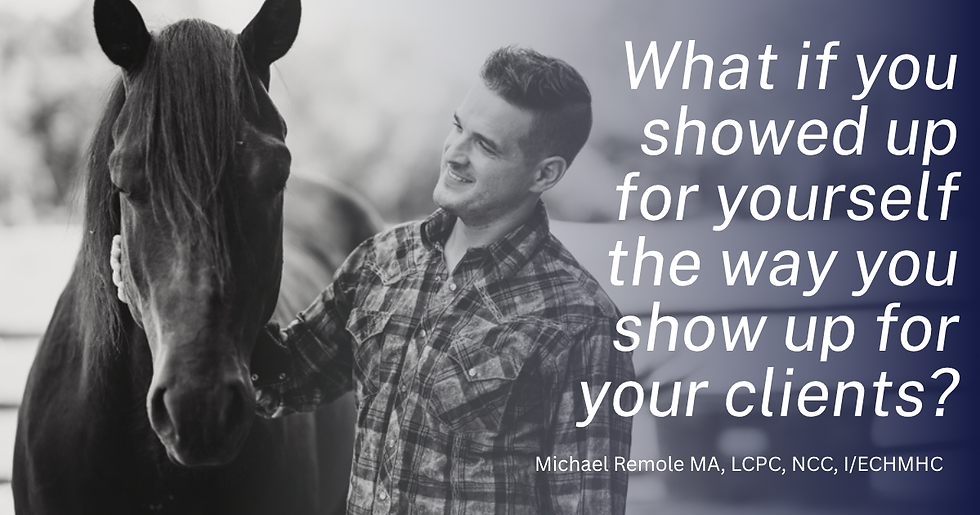
Michael Remole, MA, LCPC, NCC, NMT Mentor is the Founder and CEO of Gateway Family Services of Illinois — a trauma-informed, equine-assisted, nature-based mental health agency serving all ages in East Central Illinois. Gateway offers TF-EAP, EMDR, reflective supervision, clinical consultation, intensive retreats, and a dedicated Veterans Program.
To learn more about clinical consultation and reflective supervision at Gateway, email info@gatewayfamilyservices.org.
Interested in joining the Gateway team? Visit gatewayfamilyservices.org/joinourteam.


Comments